EBAY: WILLKOMMEN IM 21. JAHRHUNDERT!
Als ich im März in die USA gezogen bin, wollte ich gerne meine bei eBay hinterlegte Anschrift ändern. Das Aktualisieren der Liefer- und Rechnungsadresse klappte problemlos, nur die Adresse, die eBay für mich in ihrem eigenen System fährt, ließ sich nicht aktualisieren:
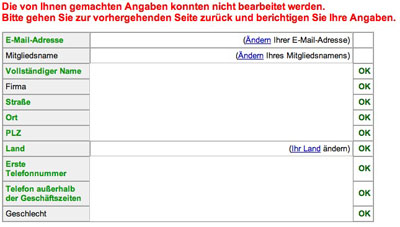
Ich hielt das damals für einen der zahlreichen Systemfehler bei eBay und kümmerte mich nicht weiter darum. Erst als ich vor kurzem mal wieder einen Artikel kaufte, erinnerte ich mich wieder daran. Und siehe da: das Ändern der Adresse funktioniert immer noch nicht. Als Antwort auf meine Mail an den eBay-Kundendienst bekam ich dann folgende Nachricht:
Sehr geehrter Herr Wenzel,
vielen Dank fuer Ihre Nachricht. Sie haben uns gebeten, Ihre Kontaktdaten zu aktualisieren.
Leider koennen Sie zurzeit Ihre Adressdaten nicht selbst in Mein eBay aendern. Selbstverstaendlich werden wir das gerne fuer Sie uebernehmen.
Um Missverstaendnisse auszuschliessen, teilen Sie uns bitte Ihre alte und neue Anschrift mit:
- alte Adresse:
vollstaendiger Name:
Strasse und Hausnummer:
PLZ und Ort:
Geburtsdatum:
Telefonnummer:
Mitgliedsname:
E-Mail-Adresse:
- neue Adresse:
vollstaendiger Name:
Strasse und Hausnummer:
PLZ und Ort:
Telefonnummer:Sobald wir Ihre Adresse geaendert haben, melden wir uns wieder bei
Ihnen.
Wir bedanken uns schon jetzt, Herr Wenzel, fuer Ihre Geduld und Ihre
Mithilfe.
Mit freundlichen Gruessen
Xxxxxxx Xxxxxx
eBay Kundenservice
eBay ist also nicht in der Lage, ein System einzurichten, mit dem der Kunde seine Adresse aktuell halten kann. Es ist ja auch recht ungewöhnlich, dass man mal umzieht. Zur Verdeutlichung: ich möchte eine neue deutsche Adresse angeben, nicht meine Anschrift in den USA. Natürlich verstehe ich die Bedenken, dass man den bösen Buben das Ändern von Adressen und Bankverbindungen nicht unbedingt erleichtern will, sobald sie einen fremden eBay-Account unter ihre Fuchtel bekommen haben. Dass man dafür aber immer noch keinen funktionierenden Workflow gefunden hat, ist schon schwach.
Das Einführen einer Adressverifikation (z.B. PostIdent) wäre der einfachste Schritt dafür. Die Adresse ließ sich dann vorläufig speichern und nach erfolgreicher Bestätigung ins System übertragen. Jedes Online-Geldinstitut handhabt das auf die gleiche Art und Weise, warum sollte das nicht auch bei eBay möglich sein? Als hübsches Abfallprodukt ließen sich damit auch gleich der Kundenstamm verifizieren (gut fürs eBay-Marketing), Karteileichen entfernen (schlecht für die Bilanz. Weniger Kunden = weniger aufgebauschte Erfolgsstory) und ein paar finstere Gestalten (Adressfälscher) erwischen – gut für die betrogenen eBay-Kunden (ganz gleich, ob Verkäufer oder Käufer), schlecht für eBay, das immer noch [vermutlich sehr gut] an diesen über die Gebührenerhebung an den Transaktionen verdient.
TIME ZONE ADVANTAGE
When you are in America, it is often complicated to keep in touch with your beloved ones in Europe due to the different time zones. Try calling them in the morning – no one’s at home (they are still at work). Try calling them around noon, they might already have gone to bed. Don’t even think about calling someone in the afternoon – they will be very grumpy if you woke them up.
But one day you will be very lucky: your birthday lasts 33 hours. It starts at 12am CEST (3pm PDT) on the previous day and lasts (of course) until 12am… So you can actually make the most out of it. Next year I’ll be in Hawaii – 12 hours time difference to Europe 😉
I DON'T LIKE SPAM!
<img src=’/images/2007/07/mail_server-doesnt-like-spam.jpg’ alt=‘The mail server doesn’t like spam’ />
In the last days, Fred and I are noticing a highly increased number of spam messages delivered to our mail server, most of them containing file attachments to prevent spam scanners from filtering or blocking the spam messages before the end user sees them.
For now we might have found a way to block most of these spam mails, but they spammers aren’t dumb: they slightly mutate the mails from one day to the other. They started with plain-text spam, created variations of buzzwords ("/1@G|>.A"), set up image attachments, scrambled the images to complicate the OCR process, used PDF attachments and now seem to be moving to every available kind of documents out there in the IT world (namely: Excel spreadsheets, Word documents etc.). Their goal is clearly defined: bypass the filters that are currently set up by systems administrators.
Most of these administrators are responsible for ensuring that a higher number of mails per day is delivered correctly to the recipient and hence they cannot allow themselves to let their filters produce a higher number of false positives.
One other thing I see right now: hiding your e-mail address from web pages is not enough anymore. Sure, you will get much more spam once your e-mail address is published on a website and can be found through search engine crawlers, but the latest spam run only was addressed to an address that was never used on a website. I highly suspect users with infected Windows machines i.e. their Outlook [Express] etc. address books as the source for the spammers’ address lists. Cheaper than the address lists you might buy off eBay or from the guy in that dark street on the other side of your town. And of course, much more up-to-date.
So just imagine an e-mail message containing a spam attachment and malware at the same time, infecting a personal computer in that way it acts as an open mail relay, sends its address book, credit card information etc. to the spammer and continues infecting other PCs. Spam and malware combined. Cyber criminality in the 21st century.
Repeat after me[1]: E-mail is dead!
P.S. For those who missed the famous Monthy Python spam sketch: here’s the YouTube video.
Update: Joern found a good solution for this problem (in German) using additional ClamAV databases. Mika explained how to reject this type of spam with postfix (in German).
Update 2: If we’re unlucky, what we see right now was only the beginning. German IT magazine “Heise” speculates that these spam sightings might only be a test-run or (as I would rather say) a proof of concept.
[1] Borrowed from vowe.net. DRM is bad for the customer.
MACBOOK PRO POWER ADAPTOR BECOMING SMALLER
For several days, I was thinking about buying a second power adaptor and a second battery for my MacBook Pro because I’m a) on the way quite often and b) sick of crawling under my desk every morning to unplug the MBP power adaptor, putting it in my backpack, driving to the office and plugging it in again (same thing in the evenings, only in the other direction).
Luckily, this might be the first time I waited long enough for an Apple product (I remember when I bought the PowerBook, the MacBook Pro and the [multiple] iPods it only took Apple a few weeks to come up with a major improved model for the same price). The quite huge power brick for the MacBook Pro has been updated (read: shrunk) and seems to be in a much more conveniant size for travelling businessmen.
HAPPY ICAL DAY!
Happy iCal day everyone!
Today’s the day the iCal icon in Mac OS X doesn’t change when iCal is started – the static icon always displays July, 17 although the date changes to the actual date when iCal runs. I wonder if Apple finally finds a way to display a dynamic, up-to-da(y)te icon in Leopard. Until then, I keep MagiCal in my menu bar which does a perfect job.
(via: hildi, whose blog post reminded me of iCal day a few hours ahead of my [local] time…)